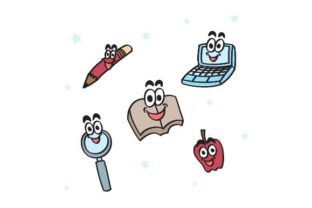
Understanding Back to School Cartoon Art for Kindergarten Classrooms
When preparing a kindergarten classroom for a new school year, the visual materials you choose play a bigger role than many educators and parents realize. Young children process images differently than older students, and the style of illustration you select can affect engagement, comprehension, and emotional comfort. Back to School Cartoon art has become a popular choice for early childhood settings, but understanding what it actually offers—and where it may fall short—requires looking beyond surface charm.
This article examines the distinct characteristics of Back to School Cartoon imagery, compares it with alternative visual approaches, and helps you decide when it fits your needs and when another style might serve better. The focus is on practical decision-making for adults who are selecting classroom resources, decorating learning spaces, or choosing art activities for young children.
What Defines Back to School Cartoon Imagery
Back to School Cartoon art refers to illustrated depictions of school-related subjects—buses, desks, books, teachers, and children—rendered in a simplified, often exaggerated visual style. The defining feature is accessible simplicity: clear outlines, bright but controlled colors, and facial expressions that communicate emotions directly. Unlike realistic depictions, cartoon versions prioritize recognizability over detail.
For kindergarten art specifically, Back to school cartoon faces have become a staple. These faces typically feature large eyes, expressive eyebrows, simple noses, and mouths that show happiness, curiosity, or gentle surprise. The proportions are intentionally child-friendly—heads are often larger relative to bodies, and features are spaced in ways that young children find familiar and reassuring.
What makes this style distinct is its predictability. A cartoon school bus drawn in this tradition will almost always have a smiling front grille, round wheels, and windows that suggest happy passengers. A cartoon teacher will have a kind expression, perhaps holding a pointer or a book, with clothing that uses simple shapes and solid colors. This consistency helps children build visual literacy and feel oriented in a new environment.
How Back to School Cartoon Compares with Other Visual Styles
To evaluate whether Back to School Cartoon art is the right choice for your context, it helps to place it alongside other common visual approaches used in kindergarten settings.
Realistic Illustrations and Photographs
Realistic images show objects and people as they actually appear. Photographs of real school buses, classrooms, and children offer authenticity. For some learning goals, such as helping children recognize actual objects they will encounter, realistic images have clear advantages. A photo of a real backpack shows exact colors, zippers, and textures.
However, realistic images often contain visual noise—background details, shadows, and variations in lighting that can distract young children. Back to School Cartoon art strips away these distractions. A cartoon backpack shows only the essential features: a main compartment, straps, and perhaps a front pocket. This clarity helps children focus on the core concept without extraneous information.
The tradeoff is specificity. If you need children to identify their own backpack among many, a realistic image is more useful. If you want to teach the concept of a backpack as part of school readiness, cartoon imagery often works better.
Abstract or Minimalist Designs
Some classroom materials use very simplified geometric shapes—a triangle for a roof, a rectangle for a door, circles for wheels—to represent school objects. This approach aligns with certain art education philosophies that emphasize shape recognition and pattern learning.
Back to School Cartoon art sits between realism and abstraction. It retains recognizable shapes while simplifying them. A cartoon schoolhouse still has a door, windows, and a roof, but the proportions may be playful and the details reduced. For young children, this middle ground often provides enough detail for recognition while remaining simple enough for them to attempt drawing themselves.
One notable advantage of cartoon-style kindergarten art is that it models drawable forms. When children see a Back to school cartoon face, they can reasonably attempt to draw a similar face themselves. This is much harder with realistic faces, which require understanding of proportion, shading, and fine detail.
Whimsical or Fantasy Styles
Some classroom art leans into fantasy—talking school supplies, animals dressed as students, or magical school buses that fly. These styles capture imagination and can make school seem exciting and magical. They are especially useful for storytelling or dramatic play.
Back to School Cartoon art is generally more grounded. While it uses cartoon conventions, it stays within recognizable school contexts. A cartoon teacher still looks like a teacher, not a wizard. A cartoon desk still resembles a desk. This groundedness matters for children who are anxious about starting school. Mixing fantasy with school orientation can sometimes confuse children about what to expect, whereas cartoon realism offers comfort through familiarity.
That said, the best approach often combines styles. Using Back to School Cartoon imagery for daily routines and classroom labels, while reserving fantasy styles for story time or creative play, gives children both clarity and wonder.
Strengths of Back to School Cartoon Art for Kindergarten
Several specific strengths make this style particularly well-suited to early childhood settings.
- Emotional accessibility. Cartoon faces convey emotions openly. A smiling cartoon teacher face communicates warmth and safety. Children who cannot yet read facial expressions easily interpret these simplified cues.
- Memory and recall. The predictable features of cartoon imagery help children remember what they have seen. A cartoon lunchbox with a distinctive color and shape is easier for a four-year-old to recall than a photograph of a lunchbox with complex branding.
- Low intimidation factor. Realistic images of older children or adults engaging in school tasks can sometimes feel intimidating to kindergarteners. Cartoon versions feel less serious and more approachable.
- Consistency across materials. When you use a consistent illustrative style across posters, worksheets, labels, and activity sheets, children build a coherent visual vocabulary. Back to School Cartoon art supports this continuity.
Limitations and When to Choose Alternatives
No single visual style works for every purpose. Recognizing the limitations of cartoon imagery helps you use it more effectively.
Older children may find cartoons childish. While kindergarteners respond well to cartoon faces, children in first grade and above sometimes perceive them as babyish. If you are creating materials for mixed-age groups, consider whether the style matches the older children's developmental stage.
Cultural and representational concerns. Cartoon faces often use simplified features that may not represent diverse appearances well. Realistic photographs can show actual diversity in skin tones, hair textures, and facial features more accurately. If inclusive representation is a high priority, you may need to supplement cartoon materials with photographs or seek out cartoon artists who prioritize diverse character design.
Limited detail for specific instruction. If you are teaching a specific skill—such as how to hold a pencil, how to zip a backpack, or how to open a lunch container—a cartoon may not show enough detail. Photographic step-by-step images often work better for procedural learning.
Over-simplification of emotions. Cartoon faces show clear emotions, but they rarely show mixed or subtle feelings. A child on the first day of school might feel both excited and nervous. A cartoon face that only shows happiness misses this nuance. Realistic images or stories that acknowledge complex feelings can complement cartoon materials in helping children process their own emotions.
Practical Decision Factors for Choosing Visual Styles
When selecting between Back to School Cartoon art and other approaches, consider these factors:
- Purpose of the material. For routine labels, classroom decorations, and motivational posters, cartoon imagery works well. For instructional manuals, procedural guides, or detailed skill demonstrations, realistic images may serve better.
- Age of the children. Kindergarteners (ages 4–6) generally respond best to cartoon styles. For younger preschoolers, even simpler imagery may be needed. For older elementary students, a more sophisticated style may be appropriate.
- Frequency of use. Materials that children see daily—such as classroom signs or behavior charts—benefit from the comfort of consistent cartoon imagery. Materials used occasionally, such as special event decorations, can reasonably use other styles.
- Integration with curriculum. If your curriculum emphasizes drawing and art skills, cartoon imagery provides achievable models for children to imitate. If your curriculum focuses on observation and detail, realistic references are more aligned.
- Budget and availability. High-quality custom cartoon art can be expensive to commission. However, many affordable resources exist, including printable sets, clip art collections, and open-license illustrations. Realistic photographs are often free but may require curation for appropriateness and diversity.
Using Back to School Cartoon Faces in Kindergarten Art Activities
Beyond display materials, Back to school cartoon faces can directly support art activities. Many kindergarten teachers use cartoon face templates as a starting point for children to practice drawing emotions, creating self-portraits, or making cards for classmates.
The advantage here is scaffolding. A child who cannot yet draw a realistic face can often trace or copy a cartoon face template. This builds confidence and foundational skills. Over the school year, children can progress from copying templates to creating their own cartoon characters, which develops their sense of visual identity and creative expression.
One practical approach is to provide children with printed sheets showing a variety of cartoon face shapes—round, oval, square-ish—along with separate sheets showing different eyes, noses, and mouths. Children can combine these elements to create their own faces. This activity teaches decision-making, emotional vocabulary, and fine motor skills simultaneously.
Making an Informed Choice
There is no single correct visual style for every kindergarten classroom. The best decision depends on your specific goals, the children in your care, and the resources available to you. Back to School Cartoon art offers clear strengths in emotional accessibility, consistency, and learnability. It is an excellent foundation for most early childhood visual materials.
However, the most effective classroom environments typically use a thoughtful mix. Cartoon imagery for comfort and routine, realistic photographs for accuracy and diversity, fantasy elements for imagination and play, and abstract designs for cognitive flexibility. By understanding what each style does well, you can make intentional choices rather than defaulting to one approach.
When you are evaluating resources, look at how the cartoon style handles diversity, emotional range, and practical detail. Ask yourself whether the imagery supports the specific learning objectives you have in mind. And remember that the same style that delights a child in September may need to evolve as that child grows throughout the year.
Back to School Cartoon art is not a complete solution, but it is a versatile and research-supported starting point. Used thoughtfully, it helps create a classroom environment where children feel safe, oriented, and ready to learn.